If this is a health and fitness blog, why am I talking about business? Because the same way that gut instincts works in a psychological way for entrepreneurs, the gut works in a physiological way in health. Even in health and fitness, the gut is always right. And if the gut is functioning properly in the human body, you can bet that you will prosper and not suffer from poverty of health.
THE GUT
The human microbiome refers to the community of micro-organisms that live inside of our bodies. They include bacteria, fungi, and archaea. We can find them everywhere, from our tongue to our skin. But when I talk about the gut, I am referring specifically to the gut microbiota or gut flora, the billions of micro-organisms that are living inside the large intestine. These small organisms make up the majority of the human microbiome and have been in our collective genetic history since the dawn of the dinosaurs, having lived in general harmony with us. And since evolution and natural selection place pressure on things that are unnecessary in the human body, there are good reasons why they are still around.

The lower gastro-intestinal tract. Source
Just some general facts out of the way:
_ the amount of micro-organisms presiding in our GI tract outnumbers human cells 10 to 1
_ science has discovered 500-1000 different species
_ gut flora are anaerobes, organisms that do not require oxygen to survive
_ most do not harm us; in fact, they are involved in metabolic processes required for health
_ you can upset a favorable balance of gut flora to an unfavorable one
_ unfavorable gut flora has been implicated with health consequences
HOW DOES GUT HEALTH IMPACT OUR OVERALL HEALTH?
Because of their prevalence in our bodies, bacteria have a profound influence on your health. Your health through gut flora is achieved through many different ways, such as diet, immune health, and infections. Just to give you an idea of how an unhealthy gut flora can impact health is an infection of Clostridium dificile. C. diff is a terrible infection to have that is distinguished by a marked imbalance of gut flora. Interestingly, one of the best ways to treat the infection is though fecal transplantation, or adopting another person's gut flora by... shuttling their feces through your nose via tube. Sounds disgusting, yet it's true. The treatment 'resets' your gut flora and emphasizes growth of beneficial bacteria.
In terms of general health, the gut flora can work in the same way. In fact, a study done in 2006 showed that those who are obese have an abnormal gut flora (1). Further, a study done on mice in 2008 found that mice that had a 'lean' community of gut flora remained lean through the study while the mice group with the 'obese' gut flora community gained weight (2). If that wasn't enough, a review done in 2013 pooled together relevant studies showing that a gut 'dysbiosis' (imbalance) contributed to insulin resistance, a state in which your body's cells do not respond normally to insulin, a hormone responsible for clearing sugar from the blood (3). What is chin-scratching interesting is that the gut flora of obese individuals 'harvest' more energy from food, making their metabolism more efficient.
This is where research has been getting fervent in recent years. Many researchers are getting on board the ship that postulates that gut flora has a direct influence on whether you get fat or not by using mouse models. And though mouse models are not perfect, they are the best shot in the dark. Over time, more and more compounds have been getting discovered. For example, fasting-induced adipose factor (Fiaf) is a compound that is produced during fasting (another reason to fast) and is released by several cells in our body. During gut dysbiosis, fiaf levels are decreased and mouses gain weight amazingly easier than their counter-parts with sufficient levels of fiaf (7).
But that's not all. Interestingly, 70-80% of your immune system is located in your GI tract, which means that the state of your gut flora has a direct influence on how well your body's immune defenses hold up in the face of adversity (4). These little buggers are the archers of your castle walls. If they go down, infections can cross the boundary easier and invade.

Keep 'em up. Source
An overgrowth of bacteria in the small intestine in a condition known as Small Intestinal Bacterial Overgrowth (SIBO) is a nasty set-up where you can suffer minor symptoms such as nausea, gas, and constipation to severe ones like malnutriton, intestinal permeability (leaky gut), and anemia. You don't want any of these. As you can see, things can go awry in a real hurry if the balance isn't kept in check. So what can you do to improve gut health?
HOW CAN YOU IMPROVE YOUR GUT HEALTH?
You can improve your gut health through two main courses: diet and supplementation.
Diet
Through diet, you have to be more careful in what you choose to eat. The gut flora responds, and quite quickly, to what you eat. In a study done by a Duke researcher, his team found that a diet consisting of only meats and cheeses produced a bacterial community that is conducive to irritable bowel syndrome, whereas a diet consisting of only plants produced a more favorable gut flora (5). Of course, these two diets are at extreme ends of each other and the subjects were only on the diets for three days, but the study shows what kind of impact dietary changes have on the body.
Although the above study may say you should stay away from cheeses and meats, that is not the case. The meat and cheese diet produced bacteria that love 'bile', a compound that is necessary for proper fat digestion and absorption. Without enough bile, you will run into absorption issues and may eventually develop nutrient deficiencies. Balance and moderation are key.
Gut flora loves fiber. Normally**. They need it because that is their form of energy, the same way whole foods is our energy. Once fiber reaches the colon, the little suckers break down fiber and form short-chain fatty acids (SCFA) that are then used to repair, energize, and maintain the cells of the small intestine and others. But fat... isn't too much bad for you? SCFA are in a different league and have been shown to improve insulin sensitivity and decrease inflammation (6). Put another way, SCFA are your body's best form of energy and without them, you enter into a vicious cycle of poor immune system leading to poor balance of gut flora.
Yet, unlike the results you're seeing in the gym, not all fiber are the same. For example, Metamucil is wholly inferior at a health-improving standpoint compared to vegetables and fruits. The two types of dietary fibers you should concern yourself with are: insoluble and soluble fiber. Insoluble fiber acts as a weight agent. In other words, it increases the weight of your stool and allows quick passage of food through the GI tract. Your body nor the colon friends can break down these fibers. Soluble fiber does the opposite and it considered a bulking agent. It attracts water from nearby cells, swelling the size of the 'bolus' (food about to be absorbed in the small intestine) and delaying the time food leaves your stomach, known as gastric emptying; this affect leaves you full longer. Soluble fibers are also fermented by gut flora, which is what produces the SCFA. By fermenting soluble fibers, your small colleagues enhance their and your health. So both fibers have different health affects.
To get into a bit more specifics, let's dive into soluble fibers. In circles, soluble fibers are also known as prebiotics, or food for your gut bacteria. The family of prebiotics include common nutritional names: inulin (not insulin), fructooligosaccharides (FOS), and pectin (skin of apples). They have been shown in research to improve blood glucose, inflammatory markers, and decrease potentially cancerous lesions in rats (8, 9). Many progressive supplement companies will include a prebiotic compound in a probiotic supplement because the prebiotic may enhance the action of the probiotics. Then again, eating foods containing prebiotics will achieve the same thing.
**Above, note that I say "normally" because we are assuming that your gut, asides from possibly having a wacky balance of flora, is absent of glaring abnormalities. There do exists insidious conditions--irritable bowel syndrome (IBS) and functional gastrointestinal disorders (FGID)--that extend beyond just having the wrong neighbors and will cause you gutache whenever you eat Fermentable Oligo-Di-Monosaccharides and Polyols (FODMAPs), which are carbohydrates found in many foods. Essentially, FODMAP stands for the vast majority of soluble fibers that you see in the food sources list that follows. FODMAP is a large acronym where each letter stands for the type of carbohydrate. Simply put, if you are on a low FODMAP diet, you are on an extremely restrictive diet. Things that contain fructose (honey, sugar, many fruits), lactose (dairy), fructans/inulin (onions, garlic, wheat), galactans (beans, lentils, and other legumes like soy), and polyols (apricot, avocado, plums, and sugar alcohols) are off-limits because the SCFA that are produced from FODMAP cause hypersensitivity and thus pain in the gut. However, this condition is not all that common and the symptoms are obvious--if you eat any FODMAP, you will notice. On the bright side, it's not as if you have to diet like Jennifer Aniston; you can still eat and live within normal means, just with more caution. We will talk about FODMAPs more later.

A FODMAP list. Source
In general, though, if you are trying to improve your gut health, you don't need to be too worried about how much of each fiber you are taking in, just that you are getting a good balance of both. The reason I say this is because while people don't get enough fiber in general, having too much of a good thing turns into a bad thing. Too much insoluble fiber can cause intestinal irritation because its passage causes friction and too much soluble fiber can produce enough gas to cause another nuclear meltdown, even if you are not FODMAPs sensitive.
Sources of insoluble fiber include: nuts, seeds, brown rice, corn, dark leafy vegetables, tomatoes, and tuber skins.
Sources of soluble fiber or prebiotics include: artichoke, dandelion greens, leeks, onions, garlic, nuts, apples, pears, oats, legumes, berries, cucumbers, and carrots.
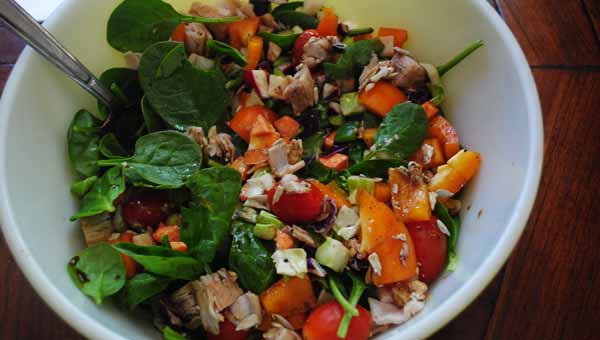
This big ass salad probably has a good blend of both. Probably. Source
Recommendation:
_ don't cut out meats and cheeses, and opt for medium fat meats
_ aim for 30-40g of fiber by incorporating more insoluble and soluble fibers, such as those found in green leafy greens, nuts, some legumes, and fruits
_ eat up to 2 cups of plain organic Greek yogurt per day
Supplementation
There is probably a supplement for every ailment and having gut dysbiosis is one of them. Right off the bat, I recommend a probiotic supplement mainly because the lot of you don't eat enough vegetables. Fruits usually are not a problem because of the big ass fruit salads you eat in the morning, which of course, usually has far too much sugar (through fructose) that it outweighs the benefits fruits confer for the gut.

Too much fructose. Source
Supplementing with probiotics is one of the mainstay treatment plans for people with gut dysbiosis in hospitals and clinics. But there, it is usually a short-term thing. For you, it should be long-term, since gut flora gets depleted every day (7). Remember the whole bit about going against conventional wisdom because it fails us more times than helps?
Don't even bother with supplementing with fiber-supplements like Metamucil. They merely provide insoluble fibers and contain zilch nutritional value.
To note, the Lactobacillus family of probiotics have been shown in research to increase expression of fiaf, which leads to delayed weight gain even in the presence of a high-fat/high-carbohydrate diet (7).
Though the research is still new, there seems to be a connection between vitamin D intake and gut flora. More specifically, low D levels have been connected with a negative change in gut flora (10).
Recommendation:
_ pick up a high-quality probiotic supplement, like Garden of Life's Primal Defense Ultra and take it first thing in the morning with warm water and parsley
_ supplement with 5,000 IU of vitamin D
WRAP-UP
In conclusion, improving your gut improves your general health, which has far-reaching benefits. Having good health will only reinforce your fat-loss and muscle gain efforts.
REFERENCES
1. Turnbaugh, PJ, et al. An obesity-associated gut microbiome with increased capacity for energy harvest. Nature 2006. 444; 21: 1027-1031.
2. Ridaura VK, et al. Gut microbiota from twins discordant for obesity modulate metabolism in mice. Science. 2013 Sep 6;341(6150
3. Shen J, et al. The gut microbiota, obesity and insulin resistance. Mol Aspects Med. 2013 Feb;34(1):39-58.
4. Forsythe P. Gut microbes as modulators of the neuro-immuno-endocrine system. PharmaNutrition. 2013 Oct;1(4):115-122.
5. Lawrence DA, et al. Diet rapidly and reproducibly alters the human gut microbiome. Nature. 2014 Jan;505:559-563.
6. Russo I, et al. Butyrate attenuates lipopolysaccharide-induced inflammation in intestinal cells and Crohn's mucosa through modulation of antioxidant defense machinery. PLoS One. 2012;7(3).
7. Molinaro F, et al. Probiotics, prebiotics, energy balance, and obesity: mechanistic insights and therapeutic implications. Gastroenterol Clin North Am. 2012 Dec;41(4):843-54.
8. Gobinath D, et al. Beneficial effect of xylo-oligosaccharides and fructo-oligosaccharides in streptozotocin-induced diabetic rats. Br J Nutr. 2010 Jul;104(1):40-7.
9. Hsu CK, et al. Xylooligosaccharides and Fructooligosaccharides Affect the Intestinal Microbiota and Precancerous Colonic Lesion Development in Rats. J Nutr. 2004 Jun;134(6):1523-28.
10. V. Mai, Q.M. McCrary, R. Sinha et al. Associations between dietary habits and body mass index with gut microbiota composition and fecal water genotoxicity: an observational study in African American and Caucasian American volunteers. Nutr J. 2009; 8:49

No comments:
Post a Comment